Chichen itza history stretches across roughly six centuries, from around 600 AD through 1200 AD, as the city grew from a regional Maya settlement into one of the most powerful political and religious centers in the Yucatan. I think the thing that makes this site genuinely remarkable is not just its age, it is how much the architecture itself tells you about who was in contact with whom, since you can read a kind of cultural conversation directly into the stone. Here is the history as I would actually explain it on a walk through the ruins, covering who built the city, how it changed over time, and why it carries the recognition it does today. This site weighs every bookable Chichen Itza tour and ticket against the others if you have not yet settled on how you are actually getting here, and if you have not yet worked out which product gets you here with real context, see which of the eight Chichen Itza tours actually pairs you with a certified guide before you go further, since a good guide turns most of what follows from facts on a page into something you can point at in person.
Who built Chichen Itza?
The Maya built Chichen Itza, beginning in the Late Classic period, and the Itza Maya people in particular are closely associated with the city’s name and its most powerful era. I would push back gently on any simple answer here, though, since the site’s later architecture shows such strong Central Mexican, Toltec-associated influence that archaeologists have debated for decades exactly how that influence arrived, whether through migration, trade, or a shared elite culture spanning both regions. My own read is that the honest answer is “primarily the Maya, shaped by outside contact,” rather than a single clean story.
Check prices & dates
Ready to visit?
Book your tickets in advance: popular time slots sell out.
When was Chichen Itza built, and how long did it last as a major city?
Construction and growth ran from roughly 600 AD into the Postclassic period, with the city’s peak influence generally placed between about 900 and 1200 AD. I would think of it less as one building project and more as a city that kept adding to itself over centuries, with earlier Puuc-style Maya structures sitting alongside later buildings that clearly borrow from Central Mexican architectural traditions. By the 1200s, Chichen Itza’s political power had faded as regional influence shifted toward Mayapan, though the site never stopped being significant to the Maya who remained in the area.
What does the name “Chichen Itza” actually mean?
It translates roughly to “at the mouth of the well of the Itza,” a direct reference to the Itza Maya people and the sacred cenote that sits within the site. I find this detail genuinely useful for understanding the city’s priorities, since naming the place after a water source tells you how central that cenote was to daily life and religious practice here, not just as a landmark but as the reason the city existed where it does.
Why is El Castillo the structure everyone recognizes?
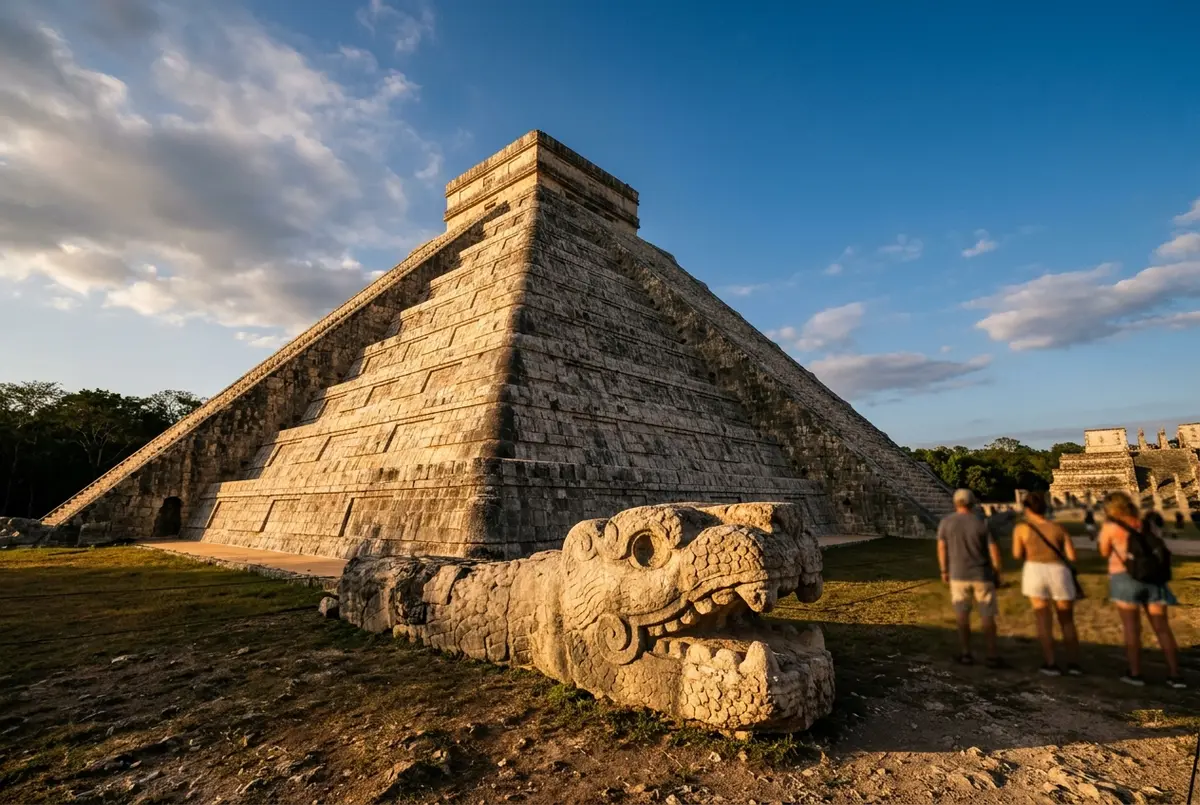
El Castillo, also called the Temple of Kukulcan, is the stepped pyramid that anchors nearly every photo of the site, and I think it earns that attention. Its staircases and platforms are widely understood to encode calendar information tied to the Maya solar year, and the structure sits directly atop an earlier, smaller pyramid, a detail that shows how later builders literally built new religious authority on top of old. My El Castillo and the Kukulkan equinox guide goes into the specific light-and-shadow effect people travel here to see, which I think deserves its own full explanation rather than a quick summary here.
What is the Sacred Cenote, and why does it matter so much?
The Sacred Cenote, or Cenote Sagrado, is a natural limestone sinkhole at the edge of the site that functioned as a place of ritual offering rather than a swimming spot. Early 20th-century excavations recovered gold, jade, and other offerings from its depths, along with human remains, which most archaeologists interpret as evidence of ritual sacrifice tied to appeals to the rain god. I would call this one of the most genuinely sobering parts of the whole site, and it is worth slowing down for rather than rushing past on the way to El Castillo. My Sacred Cenote inside Chichen Itza page covers what was found there and why, in more depth than fits here.
What was the Great Ball Court used for?
The Great Ball Court, the largest known ball court in all of Mesoamerica, hosted a ritual ball game that carried real religious and political weight, not just sport in the modern sense. I would stand inside it for a minute if you get the chance, since the acoustics and sheer scale genuinely communicate how important this game was to the people who built the space around it. Carved panels along the court’s walls depict the game and its outcomes, and I think they are some of the most under-appreciated artwork on the entire site.
What other major structures should I know about before I visit?
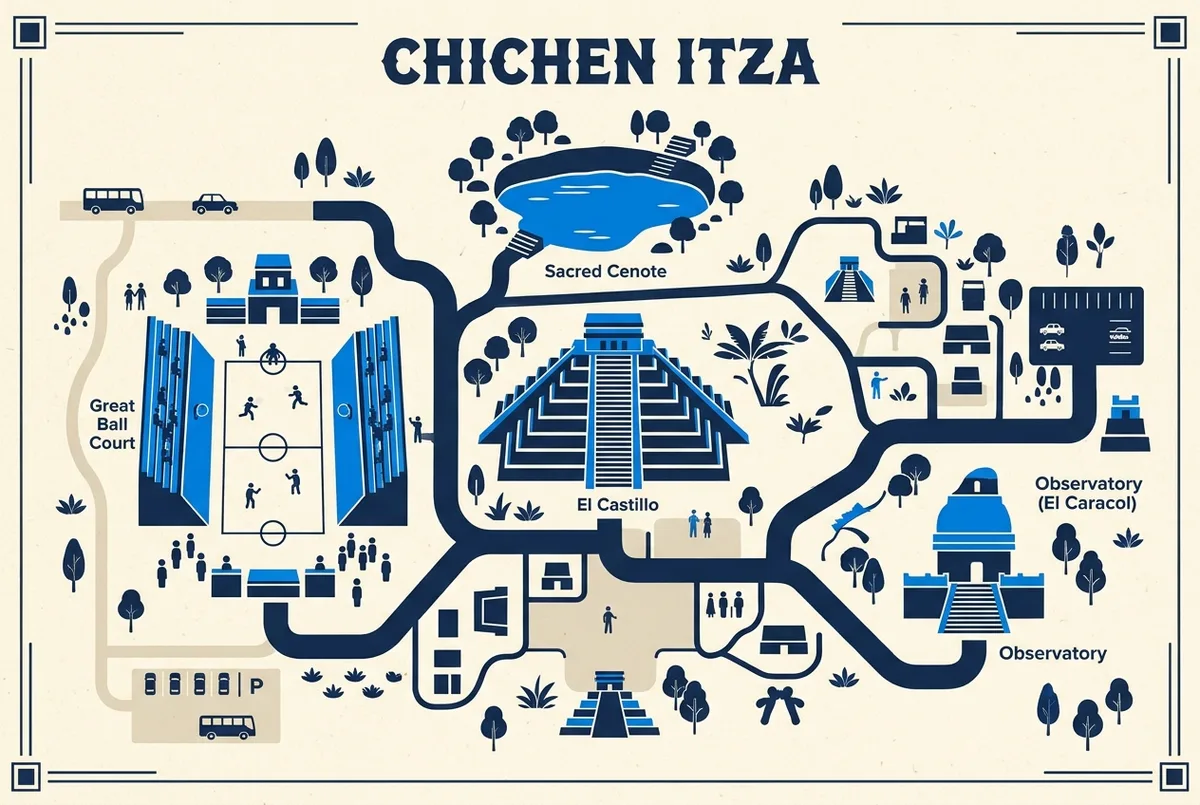
Beyond El Castillo, the Ball Court and the Sacred Cenote, the Temple of the Warriors, the Group of a Thousand Columns, and El Caracol, a round structure believed to have served as an astronomical observatory, round out the core of what most visitors see in a single guided walk. I genuinely think El Caracol gets overlooked by people rushing toward the pyramid, even though its design reflects a serious Maya interest in tracking celestial movement, particularly Venus. My guide to the Observatory, Ball Court and other structures covers each of these in the kind of detail a short overview like this one cannot.
Is Chichen Itza a UNESCO World Heritage Site?
Yes, Chichen Itza was inscribed as a UNESCO World Heritage Site in 1988, recognized for its outstanding architectural and historical significance as a major Maya ceremonial and political center. I would treat this designation as the formal, scholarly recognition of the site’s importance, distinct from the more popular, public-vote recognition that came almost two decades later.
Is Chichen Itza one of the New 7 Wonders of the World?
Yes, Chichen Itza was named one of the New 7 Wonders of the World in 2007, following a global public poll organized by the New7Wonders Foundation, a private initiative separate from UNESCO. I think this distinction actually matters: UNESCO’s listing reflects expert heritage evaluation, while the New 7 Wonders title reflects popular global voting, and I would mention both rather than conflate them, since conflating the two slightly overstates what either one actually certifies.
Can you still climb El Castillo or any of the pyramids?
No, climbing has been banned since 2008, after a visitor fell and died on the steps. I would not plan your visit expecting to climb anything here, and I think it is worth saying plainly that this restriction exists for visitor safety and structure preservation, not as an arbitrary rule. My is Chichen Itza worth it guide covers what to actually expect once you accept that the climbing-era version of this trip no longer exists.
How was Chichen Itza rediscovered by the outside world?
Spanish colonial accounts mention the ruins in passing, but it was 19th century explorers, most notably John Lloyd Stephens and the artist Frederick Catherwood, whose detailed written accounts and illustrations in the 1840s brought the site to wider international attention. I would credit Catherwood’s drawings specifically with a lot of the early fascination, since they captured a level of architectural detail that photography at the time simply could not. Serious archaeological excavation came later, starting in earnest in the early 1900s.
Who actually dredged the Sacred Cenote, and when?
Edward Herbert Thompson, an American who purchased the land the ruins sat on in the 1890s, conducted the first major excavation of the Sacred Cenote in the early 1900s, recovering a substantial collection of offerings from its depths. I would flag this history honestly rather than gloss over it: Thompson’s methods and his removal of artifacts to institutions abroad are genuinely controversial by today’s standards, and much of that material took decades to be formally addressed between Mexico and the institutions that held it. Later excavations, particularly the Carnegie Institution’s work through the 1920s and 1930s, and ongoing work by Mexico’s own INAH, have been far more systematic.
How big was Chichen Itza at its peak?
Population estimates vary significantly depending on how archaeologists define the city’s full extent, but most agree it was among the largest and most influential Maya cities of its era, with an urban footprint well beyond just the ceremonial core most visitors walk through today. I would not put too much weight on any single population figure you see quoted online, since the methodology behind these estimates differs a lot between sources, but I think it is fair to say this was a genuinely major city, not a small ceremonial outpost.
Was Chichen Itza an important trade hub, or mainly religious?
Both, and I think that combination is part of why it grew so powerful. The city sat within reach of Isla Cerritos, a coastal trading port, which connected it to long-distance trade networks across the Gulf and Caribbean, moving goods like obsidian and salt. I would not separate the religious and economic sides of this city too cleanly, since in most Maya political centers, control over trade routes and ritual authority reinforced each other rather than existing as separate concerns.
Did Chichen Itza have its own distinct art and sculpture style?
Yes, and I think the carved panels around the Great Ball Court and the reclining chac mool figures near the Temple of the Warriors are the clearest examples. These pieces blend recognizably Maya iconography with motifs that also appear at Central Mexican sites, which is exactly the kind of physical evidence that keeps the Toltec-influence debate alive among archaeologists. I would spend time looking closely at these carvings rather than only photographing the pyramid, since the detail in the stonework tells a more specific story than the skyline shot does.
How much of the site is actually open to visitors today?
A substantial core area is open, covering El Castillo, the Great Ball Court, the Sacred Cenote, the Temple of the Warriors group and El Caracol, though the broader archaeological zone extends further than what a typical visit covers on foot. I would not expect to see every excavated structure in one visit, and I would not consider that a loss, since the structures open to the public already represent the city’s most significant buildings.
How much of this history will a guided tour actually cover?
A good certified guide covers the core timeline, the main structures, and the Sacred Cenote’s significance in the course of a standard visit, which is exactly why I keep pointing people toward a guided option over a bare entrance ticket throughout this site. The Chichen Itza, Cenote & Valladolid Tour builds that guided context into a full day that also includes a cenote swim, and I would pick it over a self-guided visit specifically because this history is genuinely hard to piece together from on-site signage alone.
Is the equinox shadow effect at El Castillo scientifically settled?
Not entirely, and I think the honest answer is more interesting than a simple yes. The widely described serpent-shaped shadow effect along the pyramid’s staircase during the spring and fall equinoxes is a genuinely striking sight that draws large crowds every year, but some researchers have questioned exactly how precisely it was engineered versus how much is a more general seasonal lighting pattern that later observers framed into a specific story. I would go see it for the atmosphere and the crowd it draws, while holding the “perfectly engineered to the day” version of the claim a little loosely, since serious debate about its precision still exists.
Does knowing the history change how I should plan my visit?
I think it does, in a practical way. Once you know the Sacred Cenote and El Caracol are both genuinely worth real time, not just quick photo stops on the way to El Castillo, I would build your visit around seeing all of it rather than rushing straight to the pyramid and calling the day done. My types of Chichen Itza tours guide can help you pick a format that gives you enough time on site to actually do that.
Why does the mix of Maya and Toltec style matter so much to historians?
Because it is one of the clearest physical records anywhere in Mesoamerica of contact, influence, or migration between two major cultural traditions, and I find that more interesting than any single building on its own. Structures like the Temple of the Warriors show feathered serpent columns and reclining chac mool figures that closely resemble architecture found at Tula, in Central Mexico, which is exactly the kind of detail that turned this question into a decades-long academic debate rather than a settled fact.
What happened to Chichen Itza after its peak?
Its political dominance faded by around the 1200s to 1300s, with regional power shifting toward the city of Mayapan, though Chichen Itza itself was never fully abandoned and continued to hold religious significance for the Maya who remained in the region. I would not describe this as a sudden collapse so much as a gradual shift in regional power, which is a more accurate, if less dramatic, version of the story than “lost city” narratives sometimes suggest.
My take on what matters most in this history
If I had to pick the single most important fact to carry into your visit, it would be the Sacred Cenote, since it explains why the city sits where it does and grounds everything else, the pyramid, the ball game, the astronomy, in a very concrete sense of place. I would spend real time there rather than treating it as a secondary stop, and I would let a certified guide fill in the specific dates and debates that a short written overview like this one can only summarize.
FAQ: Chichen Itza history
Who built Chichen Itza?
The Maya, primarily the Itza Maya, built and developed the city from around 600 AD, with later structures showing strong Central Mexican, Toltec-associated influence.
Is Chichen Itza a UNESCO World Heritage Site?
Yes, since 1988, recognized for its architectural and historical significance as a major Maya ceremonial center.
Was Chichen Itza voted one of the New 7 Wonders of the World?
Yes, in 2007, through a global public poll run by the New7Wonders Foundation, separate from UNESCO’s own heritage listing.
Can visitors still climb El Castillo?
No, climbing has been banned since 2008 after a fatal fall, and that restriction applies to every pyramid on site.
What was found in the Sacred Cenote?
Gold, jade and other offerings, along with human remains, interpreted as evidence of ritual sacrifice tied to the Maya rain god.
I would leave this history with one real takeaway: Chichen Itza is not a single monument, it is a city that kept rebuilding its own authority in stone over six centuries, and the most meaningful way to see it is with someone who can point out exactly where one era’s architecture gives way to the next. Further background is available from Wikipedia’s entry on Chichen Itza if you want to keep reading before your trip.